When I first heard software factory, I pictured a group of AI agents producing pull requests all day.
It is more than that.
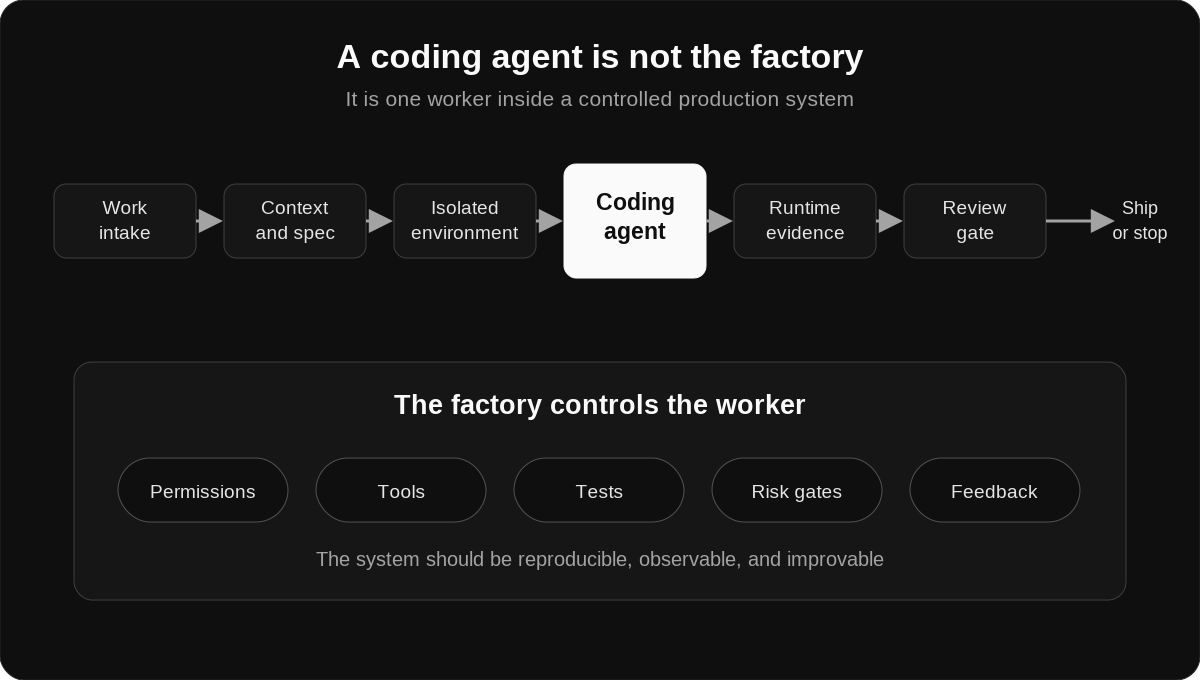
A coding agent can read a ticket, change code, run tests, and open a pull request. A software factory is the system around that agent: the tools, repository access, instructions, test environment, review process, and rules about what can ship.
The agent writes the code. The factory makes the work repeatable enough for a team to trust.
A coding agent is not a software factory
Imagine a support ticket says:
Some customers cannot complete checkout with cards issued outside Nigeria.
An agent might find the payment code and prepare a fix. But can it see the right logs? Does it have a safe test card? Which countries should it test? Could the fix break checkout for everyone else?
A factory has to answer those questions. It gives the agent the right access, a safe place to work, tests for the existing payment flows, a browser to try the checkout, and a rule that payment changes need a human review.
One successful agent run is a demo. A factory has to make the next run understandable and reliable too.
Where product engineering fits
Ben Holmes describes factory engineering as building the system of agents that builds the product.
Product engineering decides what the product should do. Factory engineering decides how an approved change becomes working software.
For the checkout issue, product engineering decides whether those cards should be supported, what the customer should see when payment fails, and how the team will know the fix worked.
Factory engineering decides which agent investigates, what tools it can use, which tests must pass, and who approves the result.
The same engineer may do both. The point is not to create another job title. It is to separate deciding what should exist from building a reliable way to produce it.
The factory also has to prove the change works. A green build is not enough for a payment fix. The reviewer should see what was tested, what happened in the browser, and what the agent could not verify.
So, are we early?
Yes, if we mean a factory that understands a company, chooses the right work, and ships without people.
No, if we mean a supervised system that handles work with a clear finish line. Bug fixes, dependency upgrades, migrations, documentation updates, and well-defined features can already move through this kind of system.
I would trust a factory with a documentation pull request much sooner than a new authentication or payment flow. Trust will grow one kind of work at a time.
The missing piece is usually not another model. It is the engineering around the model: clear requirements, a repository that can be set up reliably, useful tests, safe permissions, and a person who knows when the system should stop.
That is where I think we are. Software factories are already useful, but product judgment is not ready to leave the building.